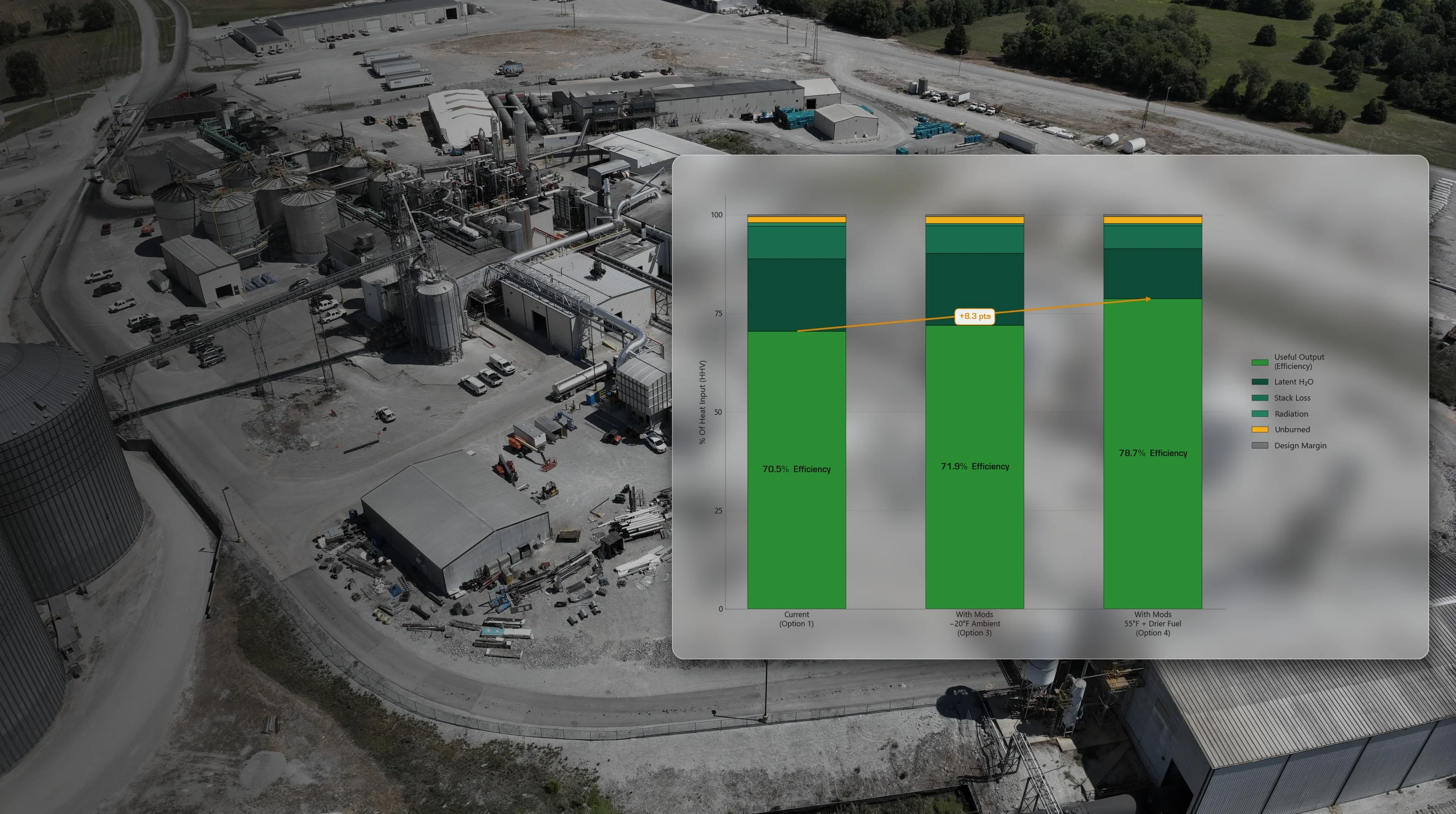
Biomass boiler capacity limits identified across 17 subsystems
Component-level performance and capacity assessment of boiler, fans, ESP, fuel handling & metering, ash handling, economizer, air heater, multiclone and emissions controls systems. Boiler and appurtenant systems were modeled at existing and target conditions to identify bottlenecks and areas for improvement, required to achieve target conditions. Capital cost estimates were then provided for each option for determination of the best option to proceed with.
Project Details
Technology
Solid fuel stoker boiler
Industry
Biorefining / Bioenergy
Location
Upper Midwest, United States
Current capacity
118,000 – 150,000 lb/hr steam
Target capacity
200,000 lb/hr steam
Scope
17 subsystem assessment
Services Provided
- Boiler performance modeling
- Heat and mass balance development
- Emissions performance modeling
- Equipment capacity analysis (fans, ESP, economizer, air heater)
- Capital cost estimation
- Fuel and ambient condition sensitivity analysis
The Challenge
The facility operated a solid fuel boiler producing between 118,000 and 150,000 lb/hr of steam but needed to increase output to 200,000 lb/hr to support both process heating and potential on-site power generation. The question was whether the existing boiler and its ancillary equipment could support the increased throughput - and if not, which subsystems would need to be upgraded or replaced.
The boiler was operating at approximately 65% excess air, well above the design range of 30–35%. This inefficiency masked the true capacity of the furnace and convection pass but also meant that backend equipment - the air heater, economizer, dust collector, and induced draft fan - was handling significantly more gas volume than necessary. Any capacity increase would compound these constraints.
Two steam conditions were evaluated, with multiple sub-scenarios for each steam condition: one producing saturated steam at 225 psig for process use, and a second producing superheated steam at 600 psig and 700°F to support steam turbine electricity generation. Each scenario required different levels of equipment modification and capital investment.
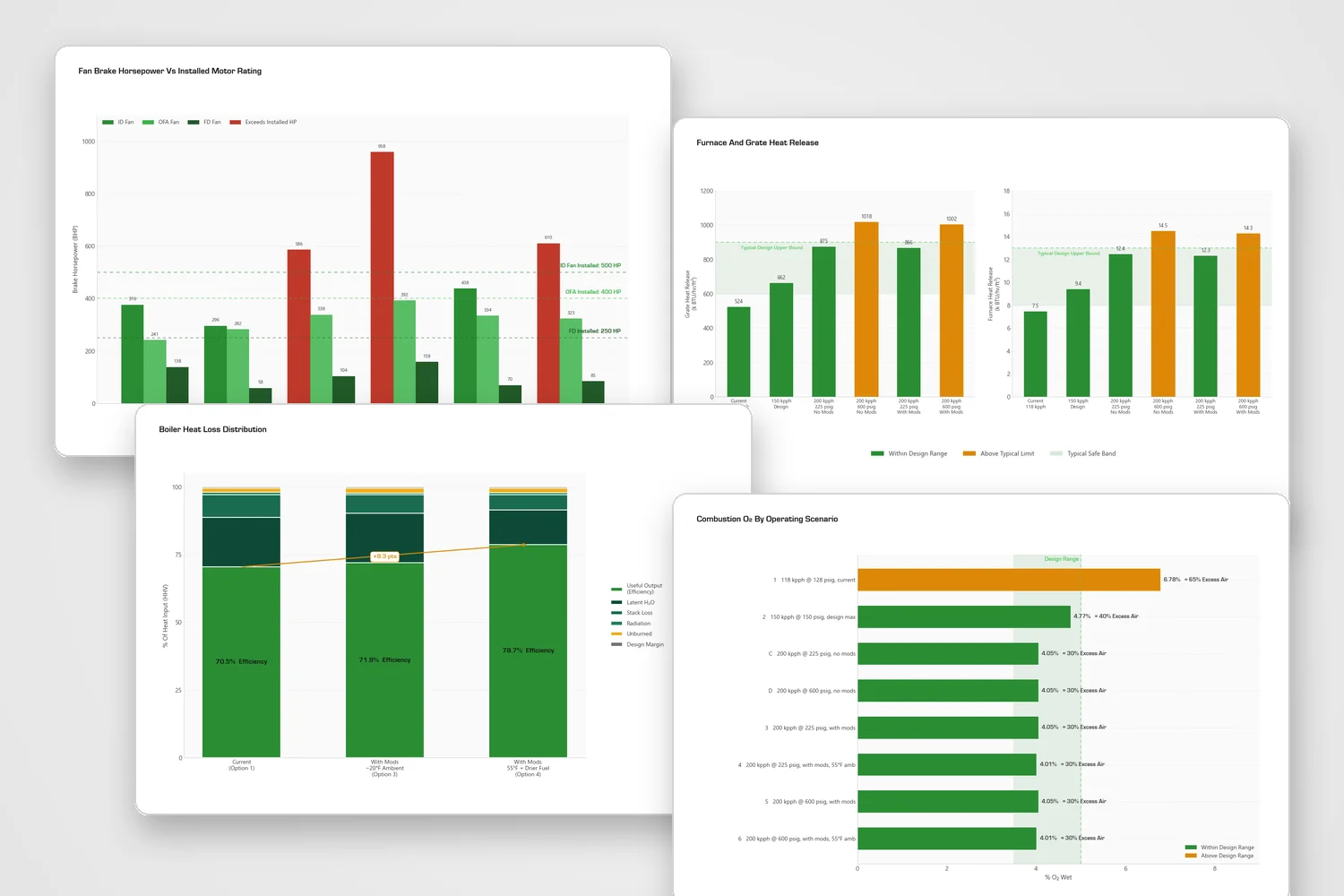
Systematic Assessment of Every Subsystem.
CPE performed a component-by-component analysis of the boiler and all supporting equipment, modeling performance across multiple fuel conditions, ambient temperatures, and operating scenarios to identify the limiting subsystems.
Performance modeling
Bottleneck identification
Emissions analysis
Capital planning
Clear Path to 200,000 lb/hr.
The analysis confirmed that the furnace and boiler heating surfaces could support the increased throughput, but identified specific backend equipment that would require upgrade or replacement.
200,000 lb/hr
Confirmed achievable
Furnace and boiler heating surfaces verified adequate for the target steam flow rate.
65% → 30%
Excess air reduction
Performance tuning and equipment upgrades projected to cut excess air by more than half, improving boiler efficiency.
17 subsystems
Individually assessed
Every component from fuel handling to stack evaluated against the expansion target.
6 scenarios
Modeled in detail
Performance predictions for two steam conditions across three ambient and fuel variations.
Have an engineering question?
Tell us about your project and we will let you know how CPE can help.